 1-888-391-1339
When a taking severs your connection to the outside world, your property becomes “landlocked.” This is a critical issue that many Georgia property owners have never considered until it happens to them. A landlocked property often loses most, if not all, of its utility and value. It’s a situation that can turn a valuable asset into a virtually worthless tract of land.
To help explain what a landlocked property is, how it happens in eminent domain, and what can be done about it, I will answer some of the questions I hear frequently as an eminent domain attorney. Remember, every property is different, and so is every case. If you have specific questions about an eminent domain taking and its effect on your property, contact us
Key Takeaways – Landlocked Property Law and Georgia Eminent Domain
- A property is considered “landlocked” when it lacks legal and physical access to a public road, which can severely diminish its value.
- Government projects, such as road widenings by GDOT, are a common cause of properties becoming involuntarily landlocked.
- Loss of road access is a type of consequential damage that may entitle the owner to compensation beyond the value of the land taken.
- A property owner is not required to accept the government’s initial offer, which may not account for the total loss in value from being landlocked.
What exactly is a landlocked property?
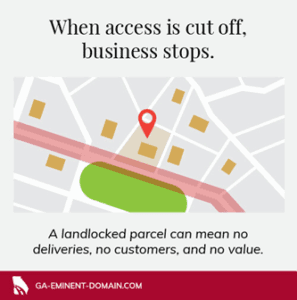 In the context of real estate law, the term “landlocked” has a very specific meaning. It has nothing to do with proximity to a lake or ocean. A property is considered landlocked when it lacks legal and physical access to a public road. This means there is no driveway, no private road, and no recorded easement granting you the right to cross a neighbor’s land to reach a street. Essentially, you are surrounded on all sides by property owned by others, with no way in or out.
Imagine a road widening project along the front of your home or business. The state takes the front 30 feet of your lot, which includes your entire driveway and frontage on the road. The house and the rest of the land remain, but there is no longer a legal or practical way to get a vehicle from the road to your property. That is a landlocked property.
The consequences of a landlocked property are often immediate and severe:
- Loss of utility:You cannot use or enjoy your property as intended. How can you get to your home, receive mail and deliveries, or have emergency services like fire trucks and ambulances reach you?
- Loss of value:A property without road access is extremely difficult, if not impossible, to sell on the open market. Its market value can plummet to a fraction of its former worth, or be eliminated entirely.
- Inability to develop or improve:You generally cannot get a permit to build or renovate a property that does not have legal road access. Lenders will usually not finance the purchase or construction of a landlocked parcel.
Under Georgia law, there is a strong public policy against the creation of landlocked properties. However, in the complex world of eminent domain, it can and does happen.
How does a property become landlocked?
While a property can become landlocked through other means, such as the subdivision of a larger estate, the most common way for an existing, in-use property to become involuntarily landlocked is through an eminent domain taking. The U.S. and Georgia Constitutions grant the government the power to take private property for “public use,” but it must pay “just compensation” for what it takes.
The problem often arises from how the condemning authority — whether it’s GDOT, a city, a county, or a utility company — defines “what they take.” They may focus only on the small sliver of land being acquired, ignoring the possibly devastating impact on the usability of the land left behind.
Here are some common eminent domain scenarios in Georgia that can result in a landlocked property:
- Road widening projects:This is the most frequent cause. A project to add lanes to an existing state highway or local road can eliminate a property’s direct frontage and driveway access. The new road design may include curbs, barriers, or change in grade that makes creating a new access point impossible.
- New highway or bypass construction:When a new highway is built, it can cut directly through a large tract of land, such as a farm or commercial property. This can create what is known as an “uneconomic remnant” — a piece of the original parcel that is now isolated on the other side of the new highway with no access.
- Limited-access highways:The state can convert a regular road into a limited-access highway, closing off many existing driveways and access points to improve traffic flow. If your property’s only access point is one that gets closed, it could become landlocked.
- Utility and pipeline projects:A wide, restrictive easement for a major gas pipeline or high-voltage power line can sometimes be so burdensome that it functionally blocks access to the rest of the property, even if it doesn’t officially sever the road connection.
In these situations, the government is not just taking a piece of your land; it may be taking away your land’s fundamental utility. This is a critical distinction that must be made when calculating just compensation.
What’s the difference between physical access and legal access?
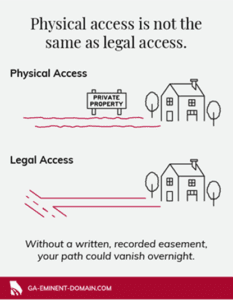 A common and costly mistake for many property owners is to confuse physical access with legal access. You may have used a dirt path across a neighboring field for decades to get to your property. That is physical access. However, if that path is not defined in a written, recorded easement, it is not legal access.
Under Georgia law, for access to be legally enforceable, it must be in writing. A verbal agreement or a handshake deal with a neighbor is not enough. If that neighbor sells their property or simply changes their mind, your path can disappear overnight, leaving you with no recourse.
An easement is a legal right to use another person’s land for a specific purpose. The most relevant type here is a right-of-way easement, which grants the right to travel across a property to get to another. For an easement to be valid and permanent, it must:
- Be in a written document
- Be signed by the owner of the property giving the easement (the grantor)
- Be properly recorded in the county land records
When an easement is properly recorded, it “runs with the land,” meaning it remains in effect even when the properties are sold to new owners. Without this recorded document, you do not have legal access. This is a crucial point when evaluating the impact of an eminent domain taking. The government’s project may eliminate your only legal point of access, and the existence of an informal path elsewhere is irrelevant to your legal standing.
What is an “uneconomic remnant” and why does it matter?
When an eminent domain taking leaves behind a portion of property that is too small, oddly shaped, or (most importantly) inaccessible, that leftover piece is referred to as an uneconomic remnant. In simple terms, the remnant has little to no independent economic value or practical use.
A landlocked parcel is the ultimate example of an uneconomic remnant. Its highest and best use has generally been destroyed.
This is where the fight for just compensation often centers. The condemning authority may offer to pay you only for the fair market value of the small piece of land they are acquiring for their project. They may completely ignore the fact that their action has rendered your remaining, much larger property worthless.
Under Georgia law, you may be owed compensation not only for the land taken but also for the consequential damages to your remaining property. The loss of value resulting from the property becoming landlocked is likely a massive consequential damage. In many such cases, the legal argument is that the government’s action constitutes a total take of your property’s value. Therefore, it may be required to pay you for the value of your entire parcel before the taking occurred, not just the part it is acquiring.
Fighting to have a remainder declared an uneconomic remnant that requires a total take is a complex legal battle. It often requires sophisticated valuation evidence from appraisers who specialize in eminent domain, and you want an attorney who knows how to build and present this specific type of case.
 Call us first. We’ll evaluate your case at no cost, and if we take your case, we’ll front the cost of the appraisal. If we can’t get you more than GDOT’s original offer, you pay nothing, including the appraisal cost. That’s part of our no-fee guarantee.2
How do I challenge the government’s lowball offer?
The appraiser who assesses your property for the condemning authority works for them. Their appraisal is often prepared with the goal of acquiring the needed property for the lowest reasonable cost to the project budget. In our experience, these initial appraisals frequently overlook or undervalue severe consequential damages like loss of access.
You should view the government’s initial offer as the start of a negotiation, not the final word. Here are critical steps to take:
- Do not sign anything: Don’t sign any deed, easement, or settlement agreement from the condemning authority without having it reviewed by an experienced eminent domain attorney. You could be signing away your rights to seek further compensation.
- Do not accept the initial offer: Accepting the first offer is almost always a mistake, especially when access is at stake. A state legislative study revealed that property owners who negotiate generally receive significantly more than those who accept the initial offer.*
- Document everything: Keep a detailed record of all communications, notices, and documents you receive from the government or its agents.
- Seek an experienced attorney: Often the key to fighting for proper compensation is to have the proper appraisal. This appraisal should not just value the land being taken; it must analyze the “before and after” scenario, quantifying the full loss in value to the remaining property due to it becoming landlocked. Your attorney can guide you at every step.
The government’s actions have put you in this position. You have the right to challenge its assessment of what it owes you.
Can I force my neighbor to give me access?
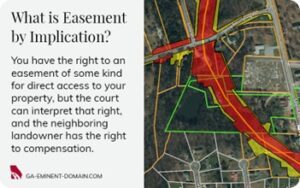 This is a common question, particularly for properties landlocked by means other than an eminent domain taking. Under Georgia law, if your property is truly landlocked, you can petition a court to grant you a private way or an easement for access over a neighbor’s land. This is often called an “easement by implication” or “easement by necessity .”
However, this is not a simple or free process. You cannot just choose the most convenient path. The court will determine if an easement is truly necessary and, if so, will decide its location, width (up to 20 feet), and the amount of money you must pay the neighboring landowner for granting it. You are also responsible for the costs of creating and maintaining the path. These legal proceedings can be expensive, time-consuming, and highly adversarial.
When eminent domain is the cause, the burden should not be on you to sue your neighbor for access. The burden should be on the government entity that created the problem to make you whole. The most direct path to potentially being made whole is to demand full compensation for the total loss of your property’s value.
We can help you fight for full and just compensation for a landlocked property
A government project that severs your road access can feel like an insurmountable problem. But you are not powerless. Georgia law demands that the government pay just and adequate compensation not only for the land it takes but also for any damages to your remaining property. A taking that landlocks your property represents one of the most significant forms of damage an owner can suffer.
Proving your full potential damages and taking on the government means skill, resources, and an unwavering focus on eminent domain law.
At the GA Eminent Domain Law Firm, we focus on representing property owners in eminent domain cases. Several of our attorneys formerly worked for a state Department of Transportation, and since we’ve been in practice, we’ve helped our clients get on average nearly 3x more than the initial offer.1
If the government is threatening to take your land and its access, you do not have to accept its offer. Contact the GA Eminent Domain Law Firm at 1-888-391-1339 today or through our online form for a free, 100% confidential case evaluation. Our team will review the facts of your case and help you understand the options you may have.
*Source: NC Legislature (2015). House Bill 127: DOT Condemnation Changes – Fiscal Analysis Memorandum (Section 2). Fiscal Research Division.