
Is the Government Taking Your Church Property?

As stewards of your congregation’s resources, you want to ensure you receive just compensation. The government’s first offer may not account for the true, long-term impact on your ministry.

Church Property and Georgia Eminent Domain Condemnation

A church is more than bricks and mortar; it is often the heart of a community –  a sanctuary, a place of fellowship, and a center for service. So, when a government entity like the Georgia Department of Transportation (GDOT) notifies you that it intends to take church property for a public project, the news can feel like a violation of something sacred.

While it is a difficult reality, church property is not exempt from eminent domain condemnation. The government has the right to take private property — including property owned by a religious institution — for a public use, such as widening a highway or installing a utility line. However, this power is not absolute. The United States and Georgia Constitutions guarantee that if the government takes your property, it must pay you “just compensation.”

The critical challenge for churches is that condemning authorities often fail to understand the unique nature and value of your property. As stewards of your church’s resources, you want to protect its assets and its future. This means you do not have to accept the government’s initial offer.

GA Eminent Domain Law Firm is here to help you. We focus exclusively on representing property owners in condemnation cases, and we understand the specific challenges that churches face.

Key Takeaways for Church Property Condemnation in Georgia

  • Church property is not immune to eminent domain takings by government entities in Georgia.
  • The U.S. and Georgia Constitutions require the government to pay “just compensation” for property it takes.
  • Condemning authorities frequently undervalue church properties and may fail to assess them as unique “special use” properties.
  • Impacts from a taking can include reduced parking, loss of access, removal of signage, and the inability to expand in the future.
  • Even a small taking of land can result in significant “severance damages” to the remaining church property, reducing its usefulness and value.
  • An experienced eminent domain attorney can fight to maximize compensation and protect the ministry’s long-term interests.

Why choose GA Eminent Domain Law Firm for your church’s eminent domain case

Choosing the right legal representation for you is a profound decision for any church leadership team. You are not just fighting a legal battle; you are protecting your congregation’s legacy and future. Here are some reasons why churches across Georgia can trust us to champion their cause:

  • We understand your role as stewards: We recognize that your goal is not personal enrichment, but the responsible management of the resources entrusted to your care. We approach your case with the gravity and respect it deserves, fighting for the maximum compensation to continue your ministry.
  • Exclusive focus on eminent domain: Our practice is dedicated to eminent domain law in Georgia. This singular focus gives us a depth of knowledge and experience to try to leverage to your advantage.
  • Experience from the other side: Our team is supported by several attorneys who once worked for a state DOT. We have seen firsthand how condemning authorities build their cases and value properties. This inside knowledge helps us build strong cases when we negotiate and litigate if needed on your behalf.
  • A risk-free fee structure: Your church pays no upfront costs or hourly fees. We advance all costs for experts like appraisers and engineers as needed. Our fee is entirely contingent on securing more money for your church than the government’s initial offer. You keep 100% of the original offer, and we are only paid from the additional compensation we obtain for you. If we don’t get you more money, you owe us nothing. Guaranteed.2
  • A statewide network of experts: Just compensation is proven with evidence. We have cultivated a network of Georgia land planners, engineers, and appraisers who are experts in valuing unique properties like churches. We deploy these experts as needed to try to build a powerful, data-driven case for the maximum potential value of your property and the damages you may be owed.

We handle the condemnation process for you so you can remain focused on what matters most: leading your congregation.

The constitutional right to just compensation for your church

The power of eminent domain is granted by the Fifth Amendment of the U.S. Constitution, which states, “…nor shall private property be taken for public use, without just compensation.” The Georgia Constitution provides similar protections, reinforcing your right to be made financially whole for taken property.

While it is nearly impossible to stop the government from taking property once it has demonstrated a public necessity, the fight is not lost. The true battleground in the vast majority  of eminent domain cases is centered on determining the amount of just compensation. This is where an experienced attorney can make a monumental difference.

Just compensation” is not necessarily what the government’s appraiser says your land is worth. It is a complex figure that should encompass:

  • Fair Market Value: The price a willing buyer would pay to a willing seller for the property being taken.
  • Severance Damages: Any reduction in value to the property you have left (the “remainder”) after a partial taking.
  • Other Potential Losses: This can include the cost to reconfigure your remaining property, relocation expenses, and more.

The government, like any buyer, wants to acquire your property for the lowest possible price. Its initial offer is a starting point for negotiations, not a final determination of value. Our mission is to try to ensure the final amount reflects the total harm your church may suffer.

The unique valuation of church property

A church is not a warehouse, an office building, or a retail store. It is what is known in the legal and appraisal world as a “special use” or “special purpose” property. These properties are rarely bought and sold on the open market, have unique construction features, and serve a specific function that often cannot be easily replicated elsewhere.

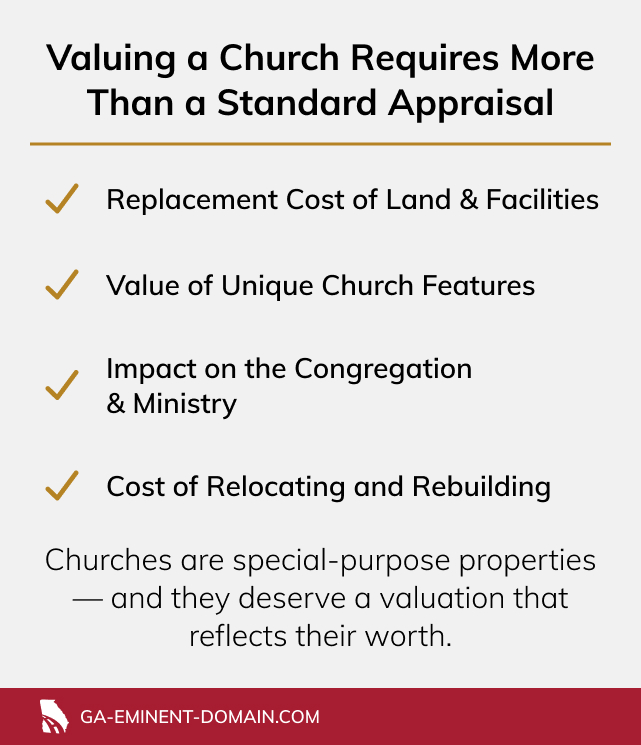
Condemning authorities often make the mistake of trying to value a church using standard commercial appraisal methods, leading to significantly low offers. They may fail to consider:

  • The Cost Approach: For special use properties, the proper valuation method is often the “cost approach,” which determines what it would cost to replace the facility. This includes the cost of acquiring similar land and constructing a new building with equivalent utility.
  • Functional Obsolescence: An older sanctuary with beautiful stained glass, high ceilings, and unique woodwork may be deemed “obsolete” by a government appraiser. We may argue that these features are essential to the character and function of the church and must be properly valued.
  • The Value of the Congregation: The location of a church is often tied directly to the community it serves. A forced relocation could fracture a congregation. Just compensation should account for the difficulty and cost of re-establishing your ministry in a new location.

Georgia Eminent Domain Law Firm attorneys. Churches require specialized valuation that considers replacement costs, unique features, congregation impact & relocation expenses.
Our attorneys work with specialized appraisers who understand the nuances of valuing religious facilities. We strive to ensure that every aspect of your property — from the sanctuary and fellowship hall to the classrooms and administrative offices — is correctly assessed to reflect its true worth for your ministry.

How eminent domain takings can impact your Georgia church

A government project does not need to take your entire church property to have a devastating impact. Sometimes, a partial taking for a road widening or utility easement can cripple a church’s operations. We try to analyze every potential consequence, including:

Loss of parking

Parking is the lifeblood of most churches in Georgia. A reduction in parking spaces can directly limit the number of congregants who can attend services and events. If the taking pushes your remaining parking below the minimum required by local zoning ordinances, you could be prohibited from expanding your facilities in the future. We fight to recover compensation not just for the land taken, but for any damage the loss of parking does to the viability of the church itself.

Impaired access and traffic flow

Will the government project change the flow of traffic around your church property? Will it eliminate a key entrance or exit? These changes can create serious safety hazards for your members, particularly children and the elderly. It can also disrupt important functions, such as funeral processions or the drop-off and pick-up of children for daycare or Sunday school. We can work with traffic engineers to demonstrate these potential damages and demand fair compensation.

Loss of signage

Your church sign is often the first welcome your community receives. If the government takes the land where your sign is located, you may not be able to simply move it. Strict municipal sign ordinances could prevent you from placing a new sign in an equally visible location. The loss of visibility is a real and generally compensable damage.

Elimination of future expansion space

Many churches acquire land with a long-term vision for growth — a new sanctuary, a youth center, a community outreach building, or a sports field. If the government takes this undeveloped land, it is affecting  your church’s future plans. The compensation offered should reflect not just the value of the vacant land today, but its highest and best use as part of your master plan for the ministry.

Permanent utility or drainage easements Sometimes, the condemning authority does not want to own your land outright but instead wants an easement. This gives it the right to use a portion of your property for a specific purpose, such as running a pipeline, power line, or drainage ditch. While you still technically own the land, you lose control over it. An easement can prevent you from building on that land forever and can create an eyesore or a safety risk. These permanent restrictions on your property often have a significant value for which you should be compensated.

Permanent utility or drainage easements

Sometimes, the condemning authority does not want to own your land outright but instead wants an easement. This gives it the right to use a portion of your property for a specific purpose, such as running a pipeline, power line, or drainage ditch.

While you still technically own the land, you lose control over it. An easement can prevent you from building on that land forever and can create an eyesore or a safety risk. These permanent restrictions on your property often have a significant value for which you should be compensated.

The Georgia condemnation process

The eminent domain process in Georgia is governed by specific laws and procedures. It can be intimidating for those unfamiliar with it. While every case is unique, the process generally follows these steps:

  1. Project announcement and initial contact: You will likely be notified by letter or in person that your church property is needed for a project. An agent representing the condemning authority (like GDOT) will make an initial offer.
  2. Appraisal and review: The government bases its offer on an appraisal it commissioned. You have the right to have your own appraisal performed. Our team engages highly qualified experts as needed to conduct a thorough and independent valuation.
  3. Negotiation: Armed with our own appraisal and analysis of damages, we enter into negotiations with the condemning authority to try and reach a fair settlement.
  4. Filing of a condemnation lawsuit: If a settlement cannot be reached, the government will file a lawsuit to formally take the property. At this point, it must deposit its estimated just compensation with the court. You have the right to withdraw these funds without jeopardizing your claim for more.
  5. Special Master hearing: In many Georgia cases, a court-appointed “Special Master” (an experienced attorney) will hear evidence from both sides and issue an award for just compensation. This is a critical proceeding where having a skilled eminent domain attorney is essential.
  6. Jury trial: If either side is unsatisfied with the Special Master’s award, they can appeal the decision and have the case decided by a jury.

From the very first notice until the final resolution, GA Eminent Domain Law Firm will be your guide and advocate, handling the legal burdens so you can remain focused on your ministry.

Trusted legal support when your ministry is at stake

Some churches may be tempted to rely on an attorney within their congregation or their regular church counsel to handle an eminent domain matter. Eminent domain is a highly complex area of law that intersects with real estate, constitutional law, and complex appraisal theory.

At GA Eminent Domain Law Firm, eminent domain law is all we do. We have helped numerous churches and religious institutions across Georgia navigate this challenging process. We know the law, we know the players, and we have the resources to build a strong case for you.

Georgia church property and eminent domain FAQs

Here are answers to some of the common questions we hear from church leaders facing condemnation.

Help protect your church’s future — Get your free case evaluation

Your church property is the physical foundation of your ministry. When the government plans to take it, you must act decisively to help protect what your congregation has built. You do not have to accept an offer that fails to account for the full and total damages your church may suffer.

Let us help you uphold your duty as stewards. Our experienced attorneys can review the government’s plans and help you understand your rights and options. Contact GA Eminent Domain Law Firm today at 1-888-391-1339 or contact us through our online form for a free, no-obligation evaluation of your case.

Get a free case
evaluation today.

There are only a handful of attorneys in GA who practice eminent domain exclusively. And even fewer with DOT experience. That’s why it’s always worth it to get a free case evaluation.

Here’s how it works:

1) Tell us about your situation.

2) We research your property as needed, using DOT maps, our own technology, and experience to see the exact effects.

3) We let you know what we think a fair offer would be. This evaluation is free, and there’s no
pressure or obligation to hire us after.

But please don’t wait to act. Waiting can hurt your case, and the cost is the same: free.

"*" indicates required fields

This field is for validation purposes and should be left unchanged.